top of page


Introduction
The Corsair was designed and principally operated as a carrier-based aircraft, and entered service in large numbers with the U.S. Navy and Marines in World War II. It quickly became one of the most capable carrier-based fighter-bombers of the war.[3] Some Japanese pilots regarded it as the most formidable American fighter and U.S. naval aviators achieved an 11:1 kill ratio. Early problems with carrier landings and logistics led to it being eclipsed as the dominant carrier-based fighter by the Grumman F6F Hellcat. Initially it was relegated to land duty with both the US Navy and Marines. Eventually the issues with difficulty in flying on and off carriers were remedied. It was powered by a 2000 HP Pratt and Whitney R-2800 Double Wasp engine turning a very large 13'4" constant speed propeller. In order to accommodate the very large propeller, the landing gear would have to be rather long, which would have been difficult to design to be strong enough to withstand hard landings aboard ship. The answer, instead was to add an inverted gull wing to provide the necessary clearance. The Corsair's initial prototype first flew in 1940.
The Kit
Tamiya has a long history of producing outstanding kits in all scales and this kit is no exception. The level of detail is outstanding and extensive. The kit offers the option of displaying the finished model with landing gear up or down (along with a nice stand included if you choose) and wings extended or folded. There is a choice of 1000 lb bombs, 5" HVAR rockets and drop tanks.
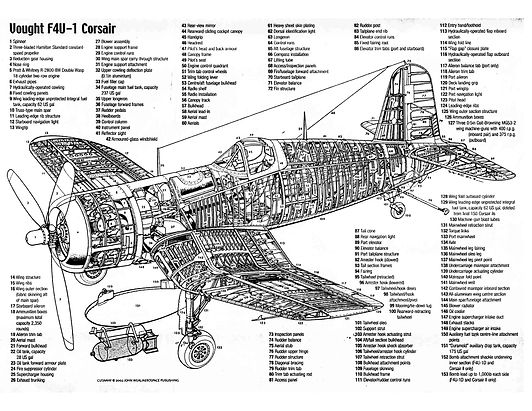
This kit is going to be built as an FG-1D, basically an F4U-1D built by Goodyear instead of Vought. Any minor differences between the two versions are insignificant for modeling purposes. I found an excellent cutaway drawing of the aircraft, which will be very helpful. This one is a -1A not -1D but for what I need it for it is more than sufficient
This build will have a very personal story behind it. I had a second cousin, LTJG John Sanford Weeks, who was attached to Bombing Fighting Squadron Eighty Five (VBF-85) embarked in USS Shangri-La (CV-38). He was flight lead on July 15, 1945 and was on a "rocket run" on Japanese shipping in the Otaru Harbor, north of Hokkaido, Japan. John took hits to his engine but managed to successfully ditch his aircraft. He was successful in extricating himself from the aircraft before it sank but he was never recovered. He was only 23. He was awarded a posthumous Distinguished Flying Cross for the mission. Ironically, John had enough rotation points to go home 2 months before this mission but made the fateful decision to "stick it out" until the end of the war, a testament to his strong character and dedication to his squadron mates.


The Build
As is customary for me, I start with the nose and work my way aft. The engine provided with the kit is very good but I want to do better. I guess at 68 and with almost 60 years of building models I guess I am starting to get lazy in my old age. I have an Eduard BRASSIN R-2800 engine that is designed just for this kit. In addition to the engine, it comes with a highly detailed cowling ring as well as cowling panels and cooling flap ring. That will save me plenty or scratch building as well. Oddly enough, there is no accessory section. However, since the kit basically stops at the firewall I guess that makes sense. I plan to open panels not only to the engine but the accessory section, so I will just scratch build an accessory section. Also, doing this will also include scratch building the oil tank, fire suppression tank, engine mounts, supercharger trunks and blowers as well as various wiring and plumbing. The engine is truly a kit unto itself, with individual cylinders and heat shields, valve push rods, oil pump, magnetos, engine body, "bullet nose", etc. You can always judge the quality of an engine kit by how fine the cylinder cooling fins are. These are so fine they almost need magnification to see them. They are very much to scale!
bottom of page